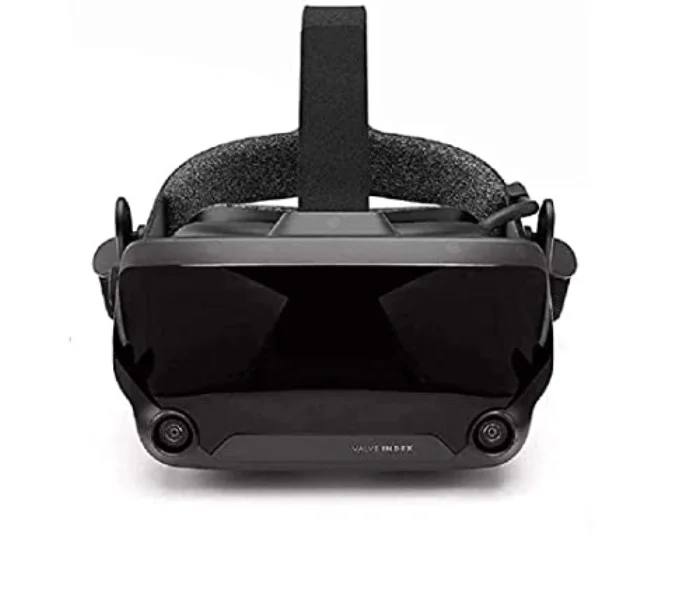
The Valve Index is the enthusiast's PC VR headset. It launched some years ago, and newer rivals have overtaken it on raw resolution, but it remains beloved by sim racers, flight-sim pilots and rhythm-game players for reasons that do not show up on a spec sheet: buttery-smooth motion, superb tracking and the best controllers in VR. It demands a serious PC and setup, and rewards those who give it one.
Who is the Valve Index for?
The Index is the right headset for the committed PC VR player who already has, or is willing to build, a proper room-scale setup. It is a tethered headset that needs a powerful gaming PC and two external base stations mounted in your room, and in exchange it offers a level of refinement that casual headsets do not. If you take VR seriously, play demanding titles such as sim racers and flight sims, and want the smoothest, most precise experience, the Index still belongs on your shortlist.
It is emphatically the wrong headset for a casual or first-time buyer. There is no standalone mode, the setup is involved, and the total cost once you include a capable PC is high. Anyone who wants to simply pull on a headset and play should buy a Meta Quest 3 instead. The Index is a specialist tool for a specialist buyer.
How the Valve Index performs
Refresh rate and motion
This is where the Index still leads. It runs at up to 144Hz, far above the 90Hz floor of most headsets, and the difference in fast games is obvious: motion is exceptionally smooth, which both looks better and reduces fatigue and motion sickness on long sessions. For sim and rhythm players who spend hours in the headset, that smoothness is the single biggest reason to choose it.
Field of view and tracking
The Index has a wider field of view than most headsets here, around 130 degrees, which adds noticeably to immersion. Its tracking is the gold standard: the external base stations track the headset and controllers with pinpoint, rock-solid accuracy across a large play space, comfortably ahead of the inside-out tracking on standalone headsets. For room-scale play, nothing in this group is more dependable.
The Knuckles controllers
The Index's Knuckles controllers remain the best in VR. They strap to your hand and track individual fingers, so you can naturally open your hand, point and grip, which adds a layer of presence the standard controllers cannot. The built-in off-ear speakers are also excellent, delivering convincing spatial audio without sealing your ears.
The honest downsides
Age is the headline issue. At 1440 by 1600 pixels per eye, the panels are now lower-resolution than newer rivals, so the image is less crisp than a Quest 3 or PSVR2, even if it moves more smoothly. The setup is demanding: you need a powerful PC and mounted base stations, which is a real commitment of money and space. And there is no standalone option at all. The Index is a deliberate enthusiast purchase, not a default. If you are not sure PC VR is for you, our standalone versus PC VR guide is the place to start.